
Francis of Assisi left an account of his own transformation. It begins with the people he had once gone out of his way to avoid.
Every year on October 4, people around the world mark the Feast of St Francis of Assisi, with many churches holding blessings of animals in his honour.
This year carries particular significance. Francis died on 3 October 1226, making 2026 the 800th anniversary of his death. A special Year of St Francis runs from 10 January 2026 to 10 January 2027 to mark the anniversary.
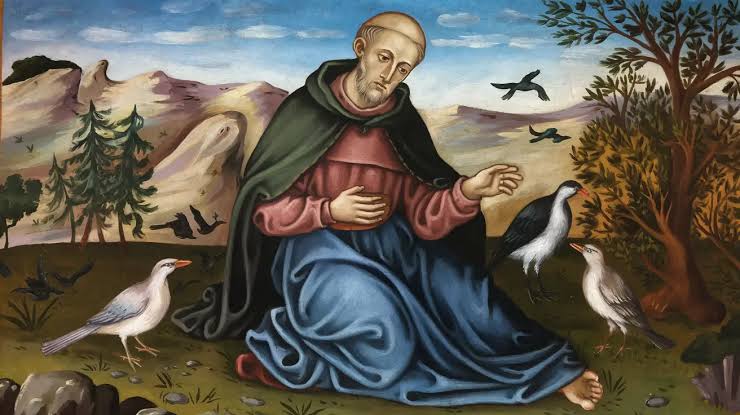
Even for those who know little about the 13th-century friar, the familiar image is easy to recognise: Francis in a simple brown habit, surrounded by birds and animals.
But the anniversary offers a chance to look beyond that familiar image. Francis’s own Testament and the earliest accounts of his life begin somewhere far less comfortable.
When he came near places where people affected by leprosy lived, he would turn his face away and hold his nose. Even when he wanted to give money, he sometimes sent someone else to deliver it rather than approach them himself.
Near the end of his life, when Francis looked back on where his transformation had begun, he started with the people he had once avoided.
The merchant’s son
Francis was the son of a prosperous cloth merchant in Assisi. He loved fine clothes, parties and dreams of becoming a knight. One evening, his companions made him “master of the revels”, handing him the money they had collected to spend as he liked.
Then war cut across that life. In 1202, Francis went to war against neighbouring Perugia and was captured. He spent around a year as a prisoner. After his release he returned home, and a period of serious illness followed. The war, prison and illness interrupted the future he had imagined for himself.
In his Testament, dictated shortly before his death, Francis wrote:
“While I was in sin, it seemed very bitter to me to see [people affected by leprosy].”
Then, he said, “the Lord Himself led me among them and I showed mercy to them”, and what had once seemed bitter became “sweetness of soul and body”.
Francis himself does not describe a single defining encounter. Later accounts describe what that change looked like.
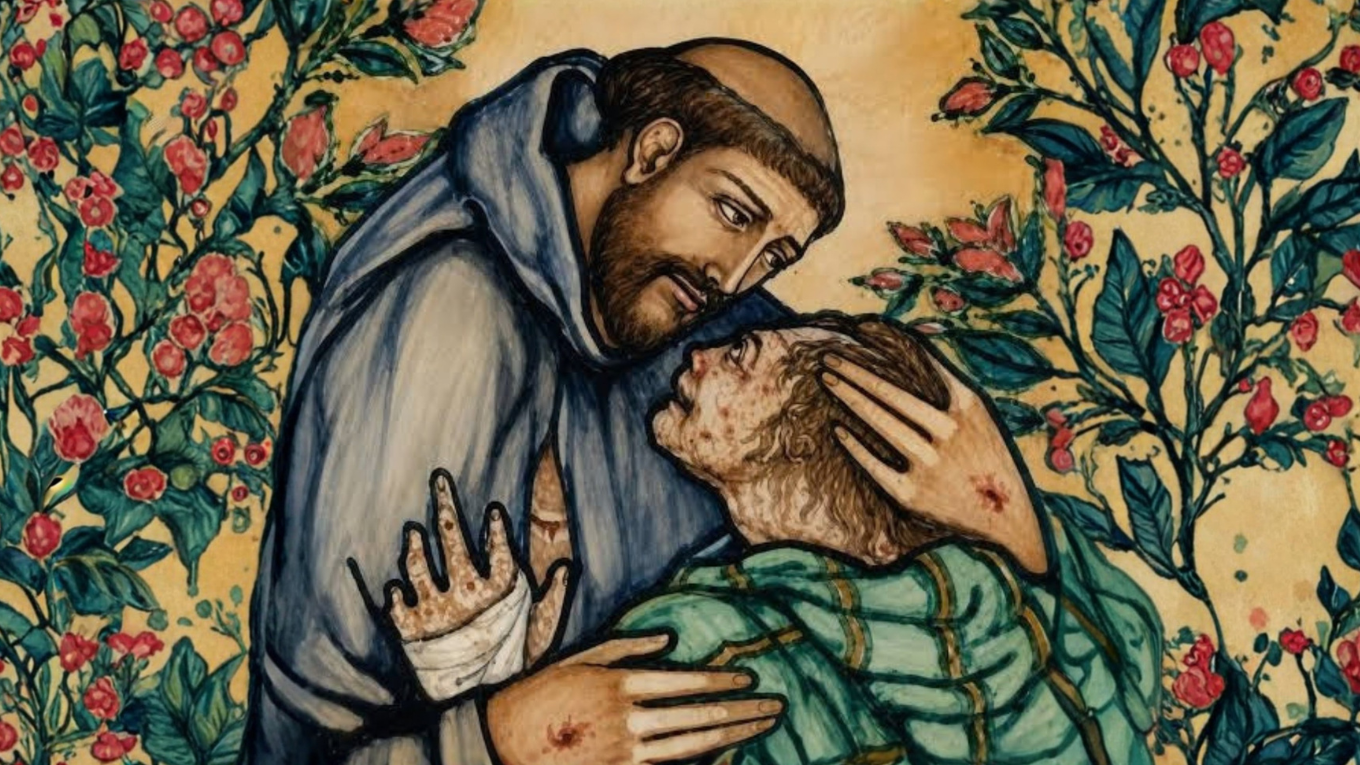
In the Legend of the Three Companions, an early account of his life, Francis is riding near Assisi when he encounters a man affected by leprosy. Instead of turning away, he makes himself dismount, gives the man money and kisses his hand. The man returns the kiss of peace, and Francis rides on.
A few days later he goes to a nearby hospital, gives money to each person there, and again kisses their hands.
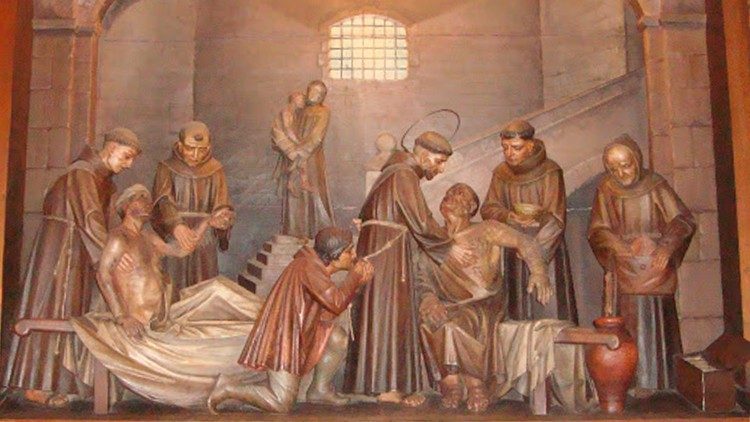
He began spending time there and caring for them. Bonaventure, writing a life of Francis decades afterwards, describes care with no distance left in it: washing feet, bandaging sores and cleaning damaged skin.
The people he had once struggled even to look at became people he was willing to touch.
Fear was not the whole story
It is easy to imagine medieval Europe as a world in which people affected by leprosy were simply driven out and abandoned.
Fear and physical separation were real. Houses for people affected by leprosy were often established beyond the boundaries of towns and cities.
The medieval term lepra covered a wider range of conditions than leprosy does today. Not everyone described that way then would receive the same diagnosis now.
In Francis’s own era, people affected by leprosy became a major focus of Christian charity. Houses were founded and supported across Europe, providing shelter, food, nursing and religious community. They depended on gifts and property from surrounding communities and could remain closely connected to nearby towns, even when they stood beyond their boundaries.
Francis grew up inside that contradiction.
Giving to people affected by leprosy could be understood as a Christian duty even while their disease inspired fear and revulsion. His own behaviour captures that tension: he would give, but sometimes through somebody else.
What changed was that Francis went himself.
Closing the gap
Francis expected the men who joined him to cross that distance too. Service among people affected by leprosy became part of the life of the early community.
In the Earlier Rule, the first rule he wrote for his brothers, Francis told them they should “rejoice” when they found themselves living among people considered unimportant or looked down upon, specifically naming “the poor and the powerless, the sick and the [people affected by leprosy], and the beggars by the wayside”.
The Assisi Compilation, a collection preserving memories of the earliest Franciscans, goes further. When “nobles or commoners” came to join the community, it says, they were told they had to serve people affected by leprosy and stay in their houses. For some of the first friars, this was part of learning what life in the community required.
As the Franciscan movement spread rapidly across Europe, that close association with these houses appears to have become less central. But it had been there at the beginning, when Francis was deciding what the new community would be.
That insistence on drawing close rather than giving from a distance became part of the early Franciscan tradition.
Eight centuries later, leprosy can be cured. But the disease has not disappeared, and neither has the stigma surrounding it.
In 2025, 167,356 new cases were reported to the World Health Organization. People affected by leprosy still experience discrimination and social isolation, and fear of that response can discourage people from seeking diagnosis and treatment.
The instinct to recoil has proved more stubborn.
A legacy of drawing close
By the final years of his life, Francis was seriously ill. The movement that had begun with a handful of followers had spread far beyond Assisi.
Yet his earliest biographer, Thomas of Celano, describes Francis still wanting to begin again, to return to the humility and service of his earliest years.
Among the things he wanted to return to was serving people affected by leprosy. Celano records his wish simply:
Francis wanted “to go back again to serving [people affected by leprosy]”.
Eight centuries later, in a world where leprosy can be cured but stigma still persists, the measure of transformation may be the same: not simply giving from a distance, but drawing close.
For more stories like this, you can browse our full collection here!